
Science at St Ambrose: Inspiring Lifelong Scientists
At St Ambrose, we are committed to providing every child with high-quality opportunities to engage in Science. We believe Science is essential for developing curiosity, critical thinking, and an understanding of the world around us. Through a broad and inclusive curriculum, we ensure all pupils experience success and enjoyment in scientific enquiry, fostering a lifelong love of discovery and learning.
Intent
At St Ambrose, we aim to develop curious, independent thinkers who have a secure understanding of the world around them. Through our Science curriculum, children will:
Our intent is to nurture inquisitive learners who ask questions, think critically, and appreciate the importance of science in shaping our lives and our future.
Implementation
Science is taught as a discrete subject following the Emmaus Curriculum, which is fully aligned with the National Curriculum. Pupils have weekly science lessons recorded in dedicated science books, ensuring progression and depth of learning. Our carefully mapped Science Overview guarantees full coverage of the National Curriculum, allowing pupils to revisit and build on prior knowledge and skills throughout their journey at St Ambrose.
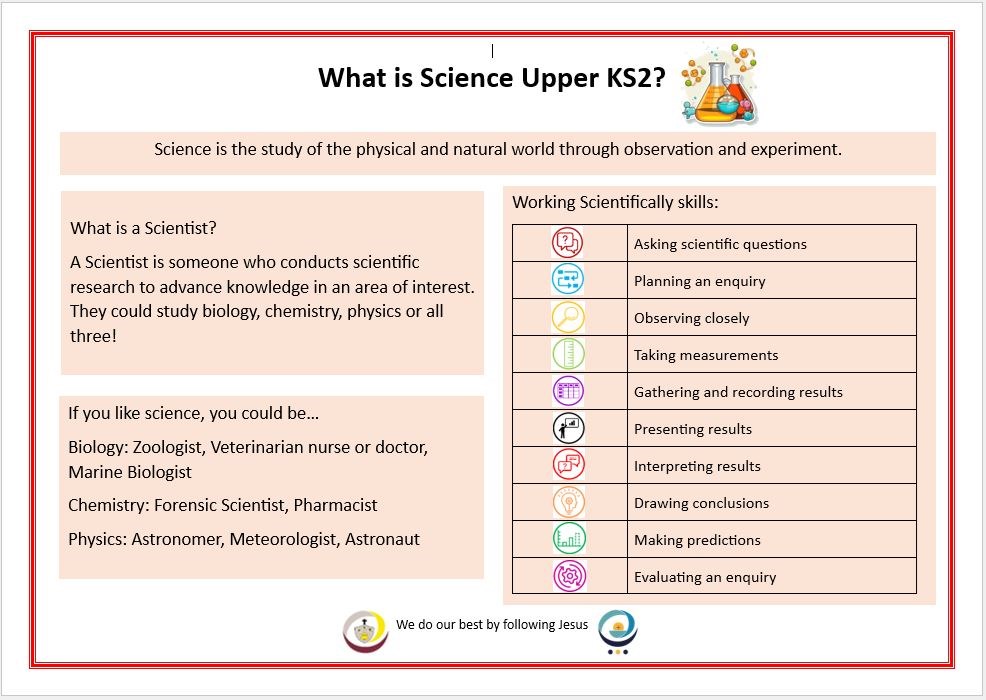
Lessons are practical, engaging, and inclusive, with opportunities for challenge and extension for more able learners. Children develop key scientific skills such as questioning, predicting, hypothesising, experimenting, observing, measuring, recording, interpreting, concluding, and evaluating. We emphasise working scientifically across all topics, ensuring pupils understand the processes behind scientific enquiry.
Science is enriched through cross-curricular links with Mathematics (data handling), English (reading and writing about science), History, Geography, Catholic Social Teaching, and British Values. Pupils also enjoy first-hand experiences, outdoor learning, and practical investigations alongside secondary sources. In EYFS, science is introduced through Understanding the World, fostering curiosity through exploration, play, and observation of nature, seasonal changes, and simple experiments.
Impact
Our Science curriculum equips pupils with the knowledge, skills, and attitudes needed to understand and explain scientific concepts confidently. Children appreciate the role of science in everyday life and its importance in shaping the future. They become independent thinkers, problem-solvers, and investigators who can plan and evaluate their own enquiries. By the time they leave St Ambrose, pupils are inspired to see science as a pathway to exciting careers and as a vital tool for improving the world. Above all, they develop a lifelong curiosity and respect for the wonders of creation.
All streams run to the sea, but the sea is not full; to the place where the streams flow, there they flow again.
Ecclesiastes 1: 6-7

Adaptive Teaching
In Science, adaptive teaching strategies are used to ensure that every pupil can access learning, develop scientific knowledge and enquiry skills, and achieve success. Lessons are carefully planned and scaffolded so that all children can work towards the same scientific learning intention at an appropriate level. Pupils with additional needs, including those with Special Educational Needs (SEN), receive tailored support through high-quality teacher guidance, clear modelling, practical demonstrations, visual prompts, adapted resources and tasks broken down into smaller, manageable steps. Where appropriate, pupils are given additional opportunities to develop their scientific vocabulary, carry out investigations, make observations and record their findings using appropriate support. Our aim is for every child to become a curious, resilient and independent scientist who asks questions, explores the world around them and confidently applies their scientific knowledge and skills to understand and explain everyday phenomena.
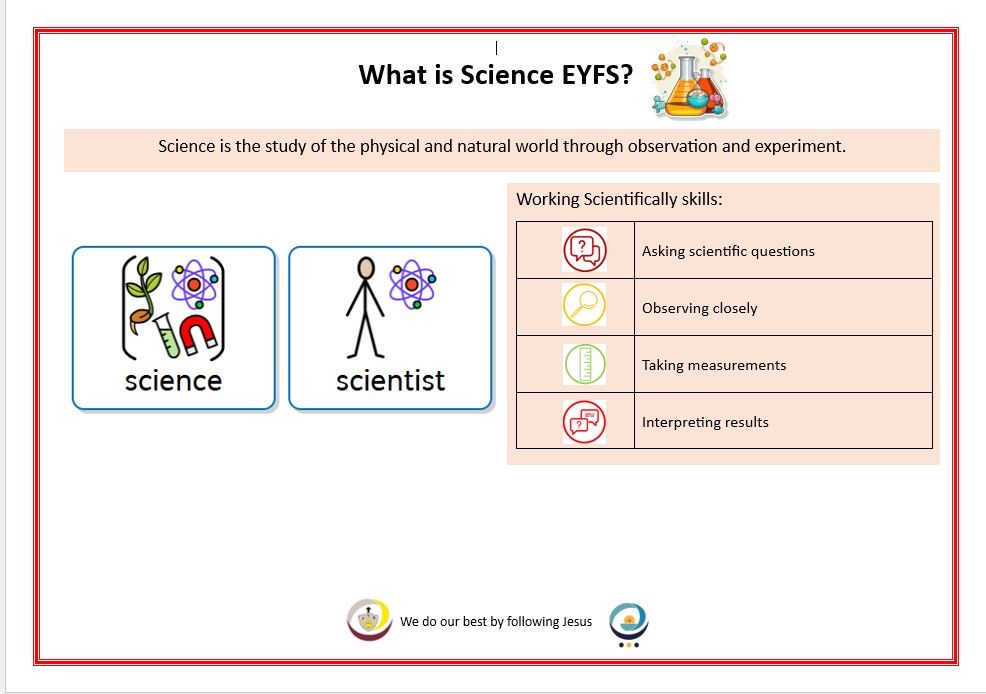
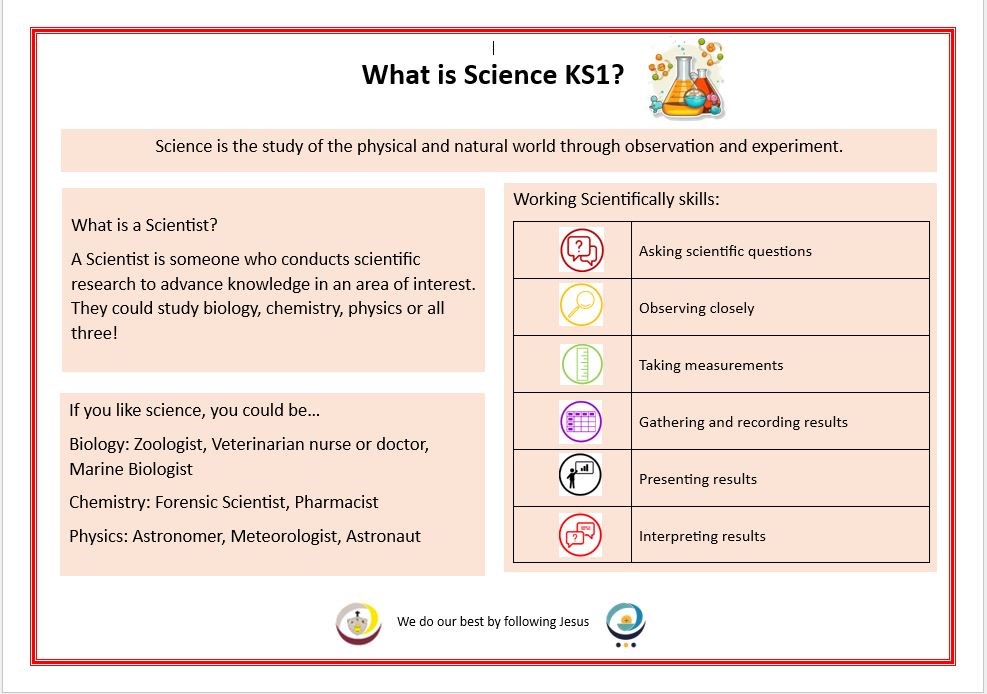
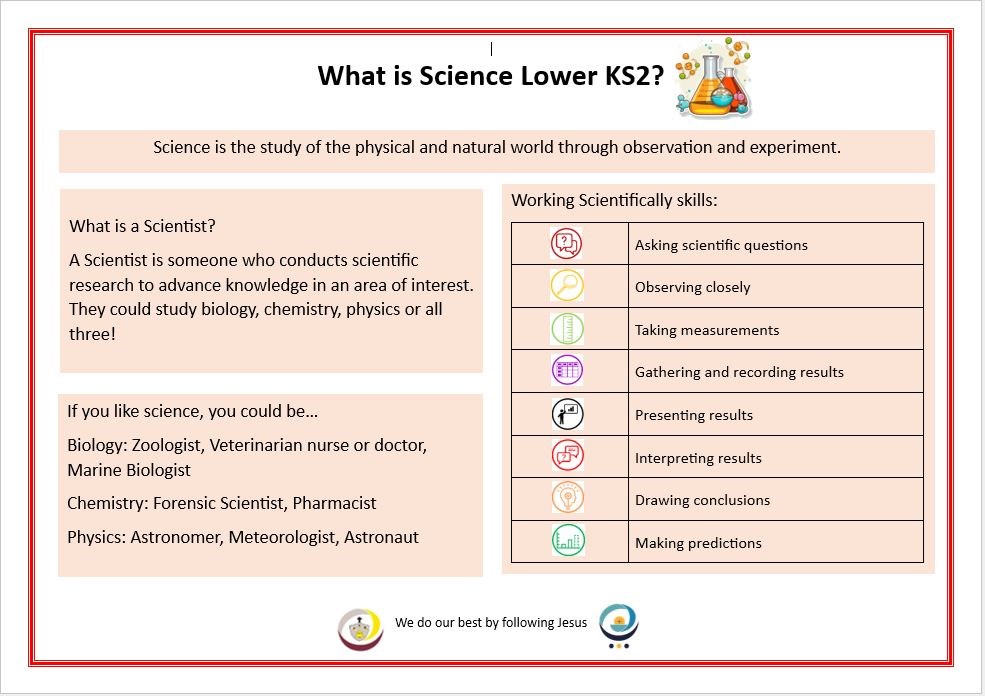
What is Science?
Curriculum
Catholic Social Teaching
In Key Stage 1, Science helps children live out CST principles such as Care for Creation and Dignity of the Human Person. Through exploring plants, animals, and seasonal changes, pupils learn that the world is a gift from God and must be cared for responsibly. Simple investigations into habitats and materials encourage respect for life and an understanding that all living things have value. By fostering curiosity and wonder, Science lessons help children appreciate creation and develop attitudes of gratitude and stewardship.
In Key Stage 2, Science deepens pupils’ understanding of CST principles like Solidarity, Common Good, and Option for the Poor and Vulnerable. Lessons on health, nutrition, and environmental sustainability highlight how scientific knowledge can improve lives and protect our planet. Pupils learn that science is not just about discovery but about using knowledge ethically to serve others and promote justice. Discussions about renewable energy, climate change, and fair access to resources encourage children to think critically about global issues and their responsibility as future caretakers of creation.

Catholic School Pupil Profile

Science at St Ambrose provides opportunities for pupils to live out the virtues of the Catholic School Pupil Profile. When children are curious and learned, they explore the wonders of God’s creation and seek to understand the world around them. Lessons encourage pupils to be attentive and discerning, asking thoughtful questions, making predictions, and evaluating evidence carefully. By developing these skills, pupils grow in wisdom and appreciation for the beauty and complexity of life, reflecting the value of knowledge as a gift from God.
Through scientific enquiry, pupils also demonstrate qualities such as being grateful and compassionate, recognising the importance of caring for creation and using science responsibly to benefit others. Opportunities for collaboration in investigations help children to be generous and eloquent, sharing ideas clearly and listening respectfully to others. By being intentional and prophetic, pupils learn to apply their scientific understanding to real-world issues, such as sustainability and health, promoting justice and stewardship. In this way, Science becomes a means for pupils to live out Gospel values and contribute positively to society.
What our children say about Science
"There are three types of science: Biology, Chemistry and Physics." (KS1 pupil).
"We learn about the world" (KS1 pupil).
"We do experiments to help us learn new things." (KS1 pupil).
"It is fascinating investigating and learning about how things work for example, the water cycle and how we can hear sounds." (KS2 pupil).
"We have fun in Science" (KS1 pupil).
"Science helps us in everyday life. For example, inventing machines." (KS2 pupil).
"You find out new information and help make the world a better place." (KS2 pupil).
Snippets of Science lessons
How can you help your child at home?


