St Ambrose Catholic Primary logo

Religious Education - Discerning Disciples

Religious Education is at the heart of our Catholic school and is central to our mission, “We do our best by following Jesus.” Through our RE curriculum, we aim to nurture children who are knowledgeable about their faith, confident in expressing their beliefs and able to recognise how the teachings of Jesus can influence their choices and actions.

Intent

Our intention is to provide a rich, ambitious and progressive Religious Education curriculum that enables every child to grow in knowledge, understanding and faith.
 
We follow Discerning Disciples, the Religious Education curriculum developed for schools within the Archdiocese of Birmingham. It supports the expectations of the Religious Education Directory, To Know You More Clearly, and provides children with opportunities to encounter Scripture, explore the teachings and traditions of the Catholic Church, and consider how faith is lived out in the world today.
 
Our curriculum is designed to develop children as discerning disciples: young people who know and understand their faith, think deeply about what they encounter and recognise their responsibility to put faith into action. We want our pupils not simply to learn about Catholicism, but to understand what it means to follow Jesus and to recognise how they can use their gifts to serve others.
 
Through Religious Education, pupils develop a secure knowledge of Scripture, Catholic beliefs, traditions, prayer, liturgy and the sacramental life of the Church. They are encouraged to ask questions, reflect, make connections and use increasingly rich religious vocabulary to communicate their understanding.
 
Our curriculum also develops respect for people of different religions, beliefs and cultures, helping pupils recognise the dignity of every person and understand their responsibility to care for others and for our common home.

Implementation

Discerning Disciples provides a carefully sequenced and progressive curriculum from the Early Years through to Year 6. It is designed as a spiral curriculum, enabling important Scripture, concepts and Catholic teachings to be revisited and developed as children progress through school.
 
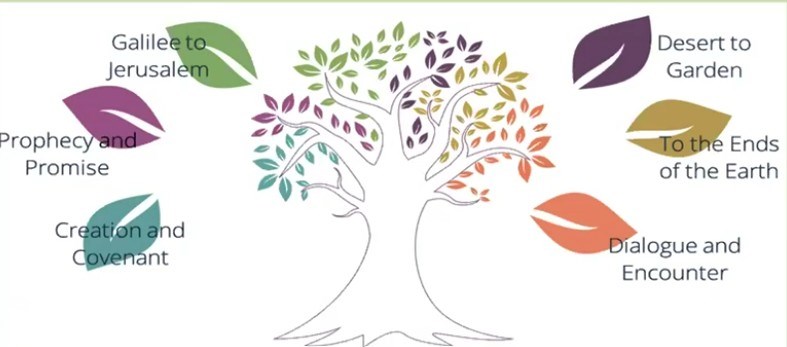
Learning is organised through six branches across the academic year:
 
Creation and Covenant – Children explore God as Creator, the gift of creation and the covenant relationship between God and humanity. They consider their responsibility to care for one another and for our common home.
 
Prophecy and Promise – Children explore God's promises throughout Scripture and the people who prepared the way for Jesus. Through the season of Advent, they consider themes including hope, waiting, trust and preparation.
 
Galilee to Jerusalem – Pupils journey with Jesus through his life and ministry. Through Gospel accounts, they explore his teaching, miracles and relationships and consider what these reveal about Jesus and God's love for humanity.
 
Desert to Garden – Through Lent, Holy Week and Easter, pupils explore forgiveness, sacrifice, reconciliation, death and Resurrection. They develop their understanding of the Paschal Mystery and the Christian message of hope and new life.
 
To the Ends of the Earth – Children learn about the Resurrection, Pentecost, the coming of the Holy Spirit and the growth of the early Church. They explore the mission given by Jesus to his disciples and consider how Christians continue this mission today.
 
Dialogue and Encounter – Pupils deepen their understanding of Catholic identity while learning to engage respectfully with people of different religions, beliefs and cultures. They develop an appreciation of dialogue, human dignity, justice, peace and the common good.
 
Across these branches, pupils encounter learning through the key areas of Hear, Believe, Celebrate and Live. They hear and explore the Word of God; develop their understanding of what Catholics believe; discover how faith is celebrated through prayer, liturgy and the sacraments; and consider how faith should be lived through their actions and relationships.
 
Teaching provides opportunities for pupils to encounter Scripture directly, acquire and use religious vocabulary, retrieve and connect previous learning, discuss important questions, reflect, pray and respond creatively. Teachers build carefully upon prior knowledge so that pupils develop increasingly deep and connected understanding as they move through school.
Impact

The impact of our Religious Education curriculum can be seen in children who are increasingly knowledgeable, reflective and confident in talking about their faith.
 
As pupils progress through school, they develop a secure and connected understanding of Scripture and Catholic teaching. They are able to recall important knowledge, use appropriate religious vocabulary and make meaningful connections between different passages of Scripture, beliefs, celebrations and ways of living.
 
Children understand that Religious Education is not simply about knowing facts. They increasingly recognise how the Gospel calls them to respond. They demonstrate this through their relationships, their care for others, their respect for creation and their willingness to serve their school, parish and wider community.
 
Pupils develop the confidence to ask and respond to challenging questions, explain their thinking and listen respectfully to the views and beliefs of others. They recognise that people may have different beliefs and experiences while understanding that every person should be treated with dignity, compassion and respect.
 
Most importantly, our pupils understand what it means to be a disciple of Jesus. They recognise that our school mission, “We do our best by following Jesus,” is not simply something we say, but something we are called to live each day.
 
Through Religious Education, we aspire for every child to leave our school with strong religious literacy, a deepening relationship with God and the knowledge, values and confidence to make a positive contribution to the world around them.